7 Tips to Improve Your Accuracy
Are you struggling to get your shots to go where you want? Are you looking to find out how you can shoot a pistol more accurately and what might affect the accuracy of your pistol shooting? Well, hang out, because I’m going to give you seven tips on how to shoot a pistol accurately.
1. Adjust Your Stance
Listen, if you don’t have a stable shooting stance, you’re not going to have the steadiness necessary to shoot your handgun accurately. Without a proper stance, it’s going to be more difficult to manage recoil and the effect it has on your body. If you’re constantly feeling like you’re being pushed backwards, your stance is likely the reason.
So, what is a proper stance? Start with your feet about shoulder-width apart. Now, don’t go crazy here; this should feel like a natural spacing of your feet. You don’t want your stance too narrow, but you also don’t want it too wide. And don’t lock your knees. Your knees are your shock absorbers; they help absorb and disperse the force of recoil. You don’t want to bend them, but think about slightly dropping your center of gravity, only a couple of inches, into your knees and feet. This will give you a sturdy foundation, help you remain centered, and make you feel less like you’re being pushed backwards. Having a strong stance allows you to shoot accurately, faster.
2. Get A Proper Grip on Your Firearm
While a good stance is important, a proper two-handed grip is probably more important. There are a lot of ways people will argue are acceptable to hold a firearm, probably even arguing it’s just as good. But honestly, they’re not. Without a proper grip, you’re going to have a difficult time getting your sights to consistently return to your point of aim, which will result in less accurate follow-up shots. From a self-defense standpoint, accurate follow-up shots and tight groups are crucial.
As your slide reciprocates, that rearward energy is stopped by your hand on the pistol, causing the muzzle to rise until the slide completes its cycle, returns to battery, and the muzzle drops back down. To form a tight grip, you need to start with a nice, high grip on the pistol. You want to get your hand as high up on the back, under the beavertail, as possible. With your support hand, fill as much of the gap as possible. The goal is to have as much contact with the surface of the firearm as you can to give you the most control.
Think of your two palms coming together. The easiest way I’ve found to explain this is to start by putting your support hand straight out, then point your fingers toward the ground. Move your support hand towards the pistol and let your palms meet, keeping your thumbs and your gun pointed forward. Place the thumb of your primary hand over your support hand thumb—don’t cross them. Then, wrap your fingers all the way around. Your grip should be as strong as a confident handshake—too tight, and you’ll start shaking, causing your sights to be all over the place. Too loose, and it won’t do you any good. Just get a strong, firm grip.
3. Sight Alignment & Sight Picture
If you don’t understand sight alignment, you’re not going to make an accurate shot, regardless of how good your stance or grip is. There are a lot of different handgun sights out there to choose from, but the most common are going to be the traditional three-dot iron sights. To complicate things more, there are two different styles of aiming with iron front and rear sights, and you’ll probably recognize which one you are.
The first is target focus. Think of this as more of a defensive style of shooting: you're focused on the threat, or the target in this case, and your sights are maybe a touch out of focus in your sight picture. You’re not looking at and focusing on your front sights.
Then, there’s front sight focus. This means the front sight is crisp and in focus in your view, while your rear sight and target are slightly blurred in the background. This is much better for precision shooting than target focus because you have a clear image of your sights, allowing you to line them up better with your target. Regardless of your style of aiming—target focus or front sight focus—you still have to line them up properly.
A good sight picture with three-dot sights starts with your dots being lined up, with equal spacing to the left and right of the front sight post. This helps ensure your front sight is centered, allowing you to hit what you’re aiming at.
4. Enhance Trigger Control
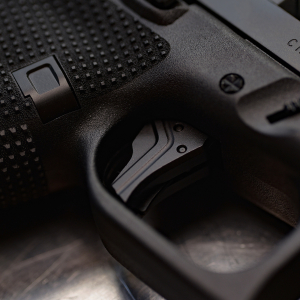
Stance, grip, and sight alignment won’t matter if you don’t have a good trigger press. So, let’s talk about what makes a good trigger press and how you can improve yours at home. A quality trigger press starts with proper finger placement. Where should you put your index finger on the trigger? Right in the middle of the last pad of your trigger finger, like this. This will help you maintain your sight picture on target and reduce the chance of your sights being moved off-target during the process of your finger pulling the trigger.
Some things to avoid while on the range: don’t slap the trigger. You should have a nice, smooth, even pull from start to finish. Slapping the trigger can cause your pistol to jerk around in your hand, resulting in shots going low or just being all over the place.
5. Control Your Breathing
Something most people don’t consider is their breathing while on the range. Breathing can affect you in a couple of ways. For starters, it prevents you from running out of breath and feeling fatigued. Think about it: are you really capable of being that steady when your body’s running out of oxygen and your heart rate increases? So, make sure you’re breathing while on the range. Timing your shots between breaths can also improve your accuracy. Shooting between breaths, during that little pause after you exhale, helps steady your body movement. When accuracy is important, reducing the movement of your sights on target is essential, especially for long-distance shooters.
6. Follow-Through After Your Shot
So, you did all that, and you pulled the trigger—your gun went bang. Now what? Follow-through. Don’t get into the habit of pulling your gun down after every shot to confirm your hits. You can see your hits with the gun up, I promise. Keep your gun up, sights on target, and think about resetting your trigger, confirming your grip, confirming your sights, and then repeating your trigger pull. This will help you build consistency with everything we covered earlier. Mentally preparing for your next shot keeps those fundamentals front and center, ensuring you’re constantly putting them into action during each shot.
7. Adjust Your Mindset & Focus
Lastly, let’s talk about your mindset while on the range. Something I always recommend is going to the range with a learning mindset. Try setting some goals—maybe it’s something you want to improve, completing a shooting challenge, or just doing better than you did the last time. Stay calm and focused on the goal of improving your skill set. Getting frustrated will only cause you to shoot worse, and you won’t have a good time.
For more upgrades and enhancements, check out the Tyrant CNC website for a full list of parts and upgrades, as well as additional content to help you make the best decisions. They also have videos and tutorials on how to add those upgrades to your firearm.